Celebrations
Ashadhi Ekadashi and our mini dindi
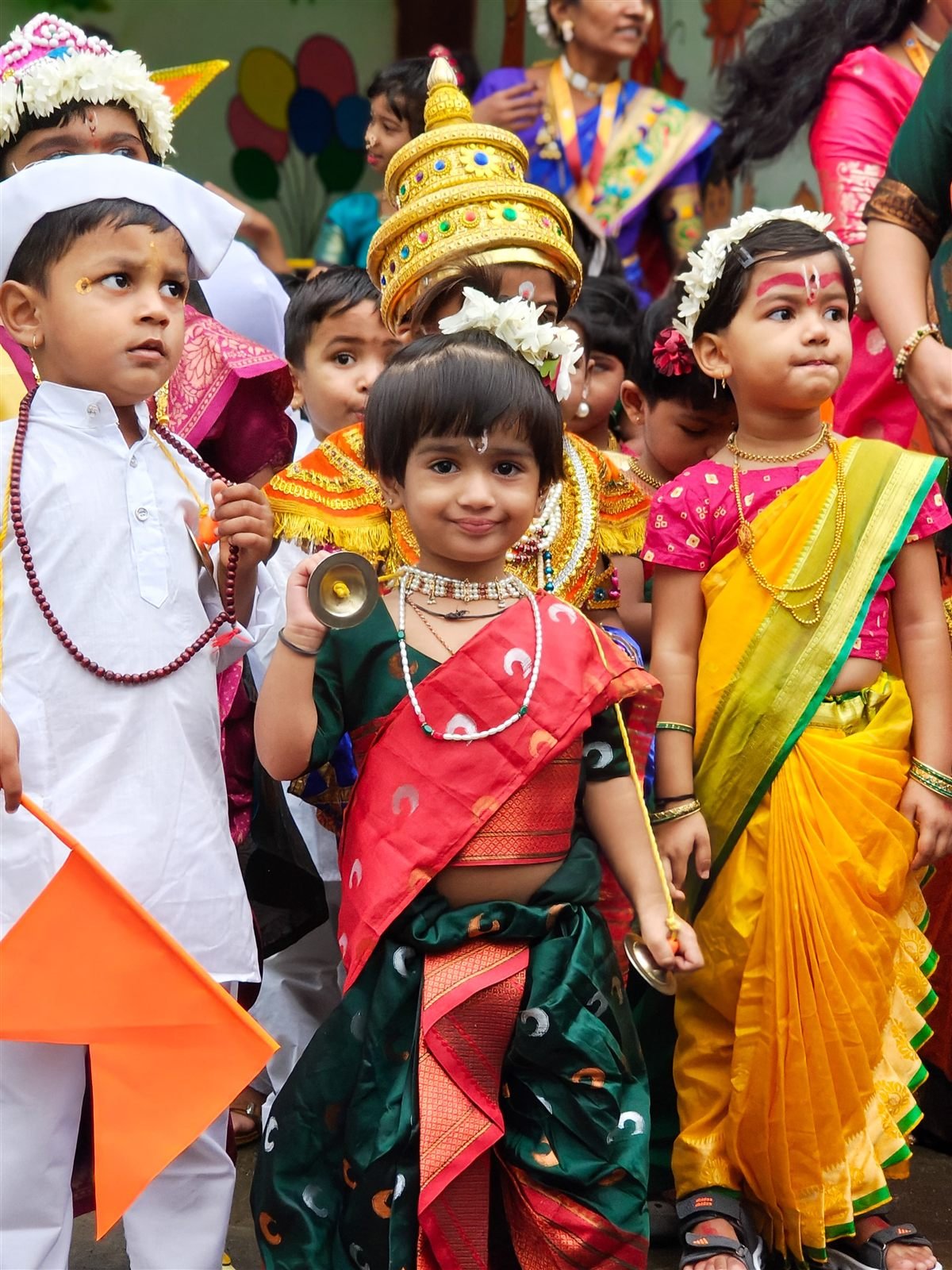
A procession of three-year-olds with cymbals, tulsi pots and considerable conviction.
Every year, hundreds of thousands of warkaris walk to Pandharpur to reach the temple of
Vitthal by Ashadhi Ekadashi. They walk in dindis — groups moving together with taal and
mridang, singing abhangs the whole way. In Maharashtra it is less a festival than a season, and
for children growing up here it is part of the landscape.
So we hold a very small one.
The mini dindi
The children process around the campus with cymbals, a tulsi pot carried on the head by whoever
has the steadiest walk that morning, saffron flags and a great deal of noise. Teachers lead the
abhangs; the children join in on the parts they know, which is usually the loudest word.
It takes twenty minutes and about four laps, at which point somebody sits down and the whole
thing dissolves. This is entirely in keeping with the spirit of it.
What it is actually teaching
A procession is a surprisingly demanding thing for a small child:
- Moving as a group — matching your pace to the people around you rather
than walking at your own speed - Rhythm — cymbals on the beat, which is early musical and mathematical
patterning - Balance and posture — carrying something on your head is real core work
- Belonging — doing a thing your grandparents do, in a place that is
becoming yours
On doing it properly
We are careful to treat it as what it is rather than a dressing-up game. The children are told
whose walk this is and where the real warkaris are going. Several of them have relatives on
that road. Marking it at school says that what happens at home is welcome here.
Vitthal Vitthal, at volume, from a four-year-old with a pair of cymbals, is a sound
worth arranging your morning around.
More celebrations
While you are here.
Admissions open
Come and see a normal Tuesday.
Walk the campus while the children are in it, meet the teacher your child would actually have, and ask us anything.