For teachers
Teachers’ Day in a pre-school: 8 activities that actually work
Eight things a three- or four-year-old can genuinely do on 5 September — and one popular idea we would skip.
India marks Teachers’ Day on 5 September, the birthday of Dr. Sarvepalli Radhakrishnan.
Most of the celebration ideas written for it assume a school child who can write a speech,
rehearse it and deliver it. A pre-schooler can do none of those things, and asking them to
produces a stilted morning that the adults enjoy more than the children.
These eight are pitched at what two- to five-year-olds can actually manage. We use most of
them; here is how the day itself
goes at Tiny Tots.
1. Let them take the register
The single best activity of the day, and it costs nothing. A child holds the register, calls
out names and waits for each reply. It demands sustained attention, name recognition and turn
management, and they take it extraordinarily seriously.
2. Little teachers
Children take turns leading something simple — counting to ten, naming colours, a rhyme
everybody knows. Role-play of this kind pushes them to reach for language and sentence shapes
they would never use in ordinary talk, because the role demands them.
3. Handmade cards, made badly
Paper, crayons, glue, whatever is in the cupboard. The instruction that matters is to the
adults: do not tidy them up. A card straightened by a teacher is a card from a teacher. The
crooked ones are the real ones.
4. A thank-you wall
A long sheet of paper at child height. Each child adds a handprint and says one thing out
loud while they do it. The saying is the activity — putting gratitude into a sentence is
harder at four than it sounds.
5. Swap the chairs
Teachers sit on the mat; children sit on the chairs. Ten minutes is plenty. The inversion is
funny to them in a way that is difficult to explain to an adult, and it makes the point about
whose day it is without a word of explanation.
6. Guess the teacher
Describe a teacher — what she wears, what she always says, which room she is in —
and let the children guess. It is a listening game and a comprehension game, and the
descriptions the children come up with afterwards are usually the funniest part of the day.
7. A flower for each teacher
One flower, handed over by one child, with eye contact and a sentence. Small, unhurried, and
far better remembered than a bouquet handed over by the principal on everyone’s behalf.
8. Tell them who Radhakrishnan was — briefly
Not a history lesson. One idea, in one sentence: there was a teacher so good that when his
students wanted to celebrate his birthday, he asked them to celebrate all teachers instead.
Four-year-olds understand generosity. They do not need the dates.
The one we skip
Rehearsed speeches. A pre-schooler reciting an adult’s words about the nobility of the
teaching profession is performing for the parents, not thanking anybody. If a child has
something to say, let them say it in their own words and accept that it will be about snack.
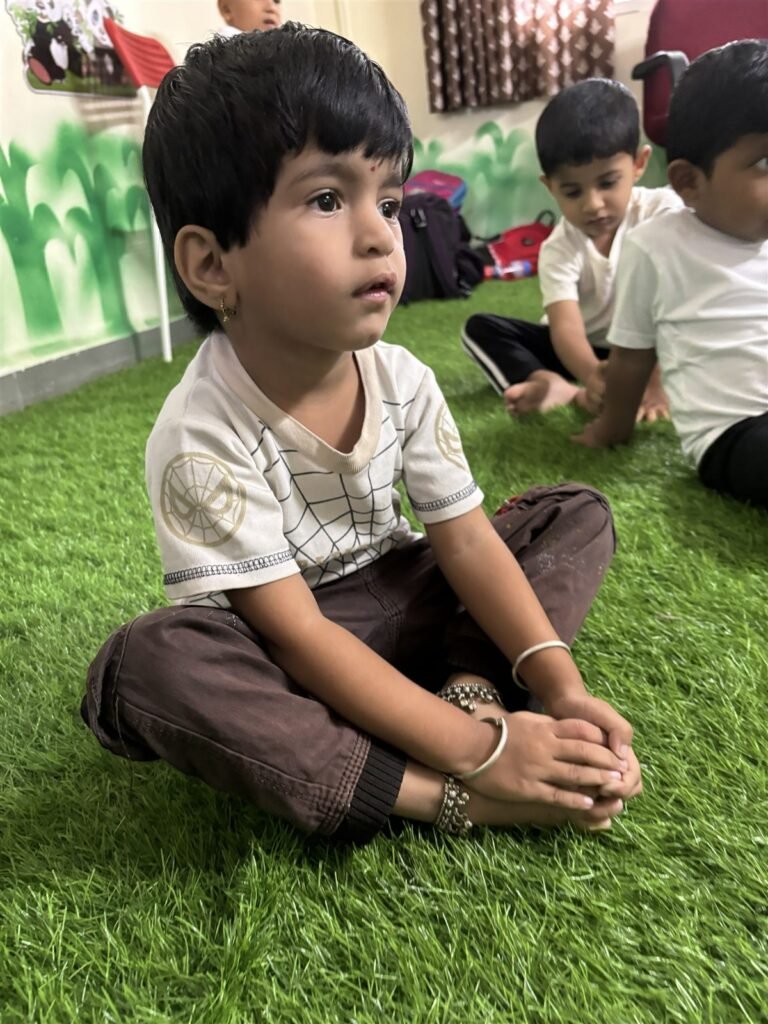
The best moment is always the same: a child, holding the register, calling out
names and waiting for each “present ma’am” with total seriousness.
More from the school
While you are here.
Admissions open
Come and see a normal Tuesday.
Walk the campus while the children are in it, meet the teacher your child would actually have, and ask us anything.